Categories
Reviews

Releasing the Kraken of Cracklings and Why Bai’s Boneless Lechon Belly is Worth Writing Home About

IMG_4290Reeling in from the holidays where the obvious gain in girth remain as evidence, one has to say that some calories were worth more time than others. Christmas is the longest holiday in the Philippines starting off in September and ending with the celebration of 3-Kings in January. There’s just too much indulgence with comfort food that we could actually remain comfortable with.

In extreme cases over the holidays, I shared the table with an old friend who I noted was staying away from the usual indulgence of food and alcohol only to reveal that he had a mild stroke a few weeks prior. Our appetite for food which is amplified along the spirit of festivities could definitely lead us to our end. However this plethora of rich food also brings with it a certain amount of distaste for it. Filipino food during the holidays seem to be biased towards the occasion that brings it to the table rather than the culinary ensemble itself when broken up into pieces. Christmas brings a stark contrast to most Filipino dining tables in a land of feast or famine where the former overwhelms us to forget most of the lean times that passed.

The christmas holidays brings out the pigs from all us in both a literal and figurative sense. During these times we find ourselves eating for the sake of eating. Feasting seems to be a social norm that is hard to pass. Of course when someone brings lechon, both the pig and its bringer seem to be the star! But what is the roasted pig fuss all about? As a matter of fact after one too many parties, I find myself absolutely sick of lechon; especially when we’ve had to contend with its left overs, two ways and two days after the party. Once after, the lean parts are slathered and fried in butter and the rest of it being served as pinaksiw – in which the uninitiated could find himself in absolute horror as he discovers the pig’s jaw complete with its teeth while the others in the same table are fighting over its brain!

Photo courtesy of Interaksyon

I cannot say however that lechon, cannot be good. As a matter of fact, I’ve had some which are as good as good gets. Elar’s lechon seems to be as “good” as we could expect while an “authentic” Cebu Lechon could certainly spin an alternate angle from the roasters down south. Indeed the Cebuanos take lechon very seriously that they would make it a point to turn it into a regional source of pride and international acclaim as Anthony Bourdain experienced and approved. The Cebu lechon pride seemed so contagious that my sister in law’s husband who was assigned in Cebu for a time would go through the trouble of having the lechon flown into Manila via Philippine Airlines; Just so we could be educated!

The lechon was “that good”. It was served neat but highly seasoned with salt, pepper and lemon grass. The best part was the belly which seems to have concentrated and infused the meat with balanced and aromatic treatments. The best test was that the lechon did not need the “febre” or salsa/sauce. The leaner parts however, almost always tasted better when dipped in salt, pepper and vinegar. The experience was always bright, crisp and aromatic.
Push that down with an ice cold refreshing bottle of San Miguel (Pale Pilsen). Please…
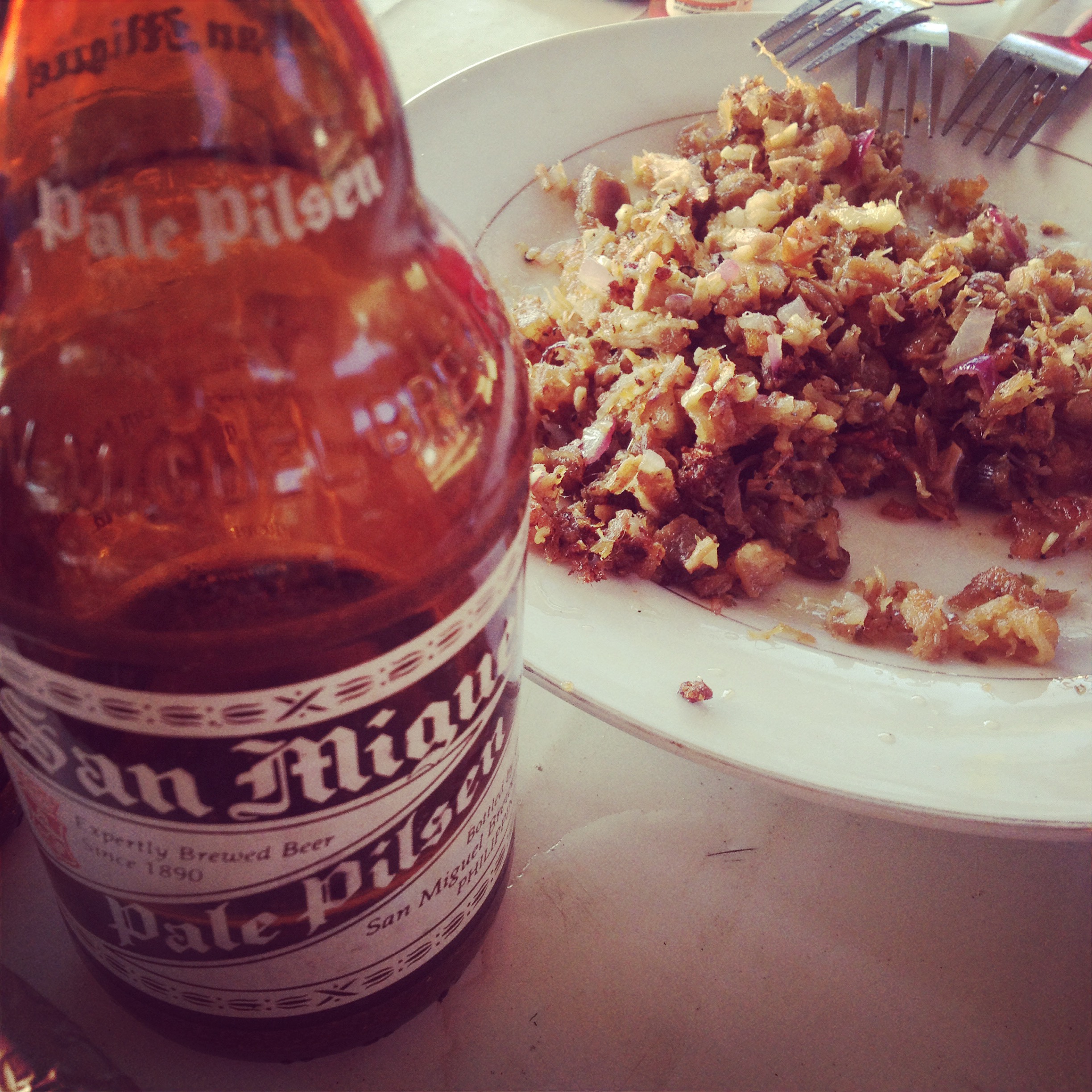
JB Magsaysay's Bagnet Sisig
JB Magsaysay’s Bagnet Sisig

However given the romance, I’d venture to say that lechon is lechon. The search for the perfect crackling pig continues. It could come from the distant past Iberian memories brought to us by Señor Armas’ Cochinillo (God Bless his immortal soul); or they may come from North and South in more recent memoirs. Past or present, I would think to be well qualified.

The recent weeks had me partaking Pig’s Face from Pappus a few long blocks away to Ilocos Sur’s famous Vigan Bagnet which we recycled to high heavens as Bagnet Sisig along the beaches of Teppeng Cove. We had the lechon in standard dress, as well as a Northern Iteration of Cebu Lechon belly from La Union! These were all perfect pigs to the crackling, but what really sets something apart was a standout of what an excellent (in superlatives) pig is supposed to be!

As said, lechon is lechon and more about the occasion and the company that brought in its presence rather than the dish itself.

IMG_4286When I had Bai’s Boneless Lechon Belly, the pig was the occasion and not the coincident! So good that I had asked my friend Paul who drove all the way from Marikina into Alabang just to try it. Wrote about it, he did.

So good that I insisted on a December 25 delivery from Dexter Ding (The Proprietor of Bai’s), who by the twist of the arm delivered it himself to feed my foodie family in Alabang where it was served among cooks and Chef! My Kuya Herman just happened to be Executive Chef when he retired from the PGA as well as having been a chef at the Four Seasons.

My feedback was nothing short of an argument with Dexter soon after. As I wanted to decry Bai’s boneless belly as lechon for the many reasons we associate with lechon. There could be good lechon and very good lechon but Bai’s was an excellent Roasted Pork Belly worth writing home about.

1521649_10152878148733329_4280400752152885546_nWith this writing I am defying his appeal. As tested in proper conditions, I found the flavor complexly layered with sophisticated aromas of lemongrass with a gentle sweet kiss of anise coming from a well founded herbal base. Anise being precarious to use (if it was) as it could anesthetize the taste buds. While the saltiness of typical Cebu lechon could be clocked at 6.5 to a 7, Bai’s can be clocked at a 5.5 on a scale of 10. In contrast to a stark salty season that we associate with typical Cebu Lechon, Bai’s seems to have come from a delicately balanced and fragrant marinade.

Bai’s brings you the best part of the lechon and takes it up several notches up and in different directions with its approach in flavor and sophistication. The mouth feel can be described as firm but tender enough not to lodge grain and sinew; there was none. The skin was a prefect crackling that dissolves in mastication. There was a presence of fat, but none that congealed into pasty lard. It is what lechon “could be” and they’ve done it.

1779717_847309875290255_1312557169512172377_nThis is not something you should wait on line for at a buffet! I believe it deserves a better place. Perhaps even in smaller portions to be shared on a dinner date with a bottle of wine. The preparation and care involved in bringing this pig to plate can satisfy even the most discerning epicurean. It’s gourmet lechon if there was such a thing?

Well, at least now there is!

Categories
Uncategorized

Getting the Best out of the Worst! 4-Ways You Can Make The Best Out of the New Year!

johnbaybay's avatarJohn Walter Bay

2014 has been marked with some of the worst disasters we have seen in the region’s history. Media was abuzz and rightly so. Indeed we do not even have to look very far to appreciate the disaster of Malaysian Airlines Flights’ MH 17 and MH 370. These were disasters that are likened to a lightning striking twice in the same place within the same year. These unfortunate occurrences do prove that the worst things can happen not only once, but twice! Shortly after, just before the end of the year, the airline disaster of Air Asia QZ8501 gripped us! Lives were lost, families were affected and eventually business and everyone is affected.

On a lighter note, the year also brought about the shocking news that Hello Kitty is not actually a Cat; Despite being a Kitty! The news had taken two generations of people aghast with those who always thought…

View original post 1,036 more words

Categories
Uncategorized

Sorry, But Media Coverage of Pope Francis is Papal Bull

Categories
Health and Fitness

5 Things You Can Get to Make Your New Year’s Resolution Work

johnbaybay's avatarJohn Walter Bay

It is January 5, 2015 8:30 AM. The first full working week in the New Year 2014 and the gym is brimming with “resolutionist” from all over town. All the treadmills are humming along at a 7-minute pace, all other cardio machines are occupied and the aerobic class is fully booked. Zumba is pumping in the background. All the machinery is humming and clinking at a frenetic pace. Fast forward 30 days later and 50% of these resolutionists will be gone. Many of the treadmills would be unplugged to save energy and what would be left are the typical gym rats shaking their protein shakes at the sidelines giving unsolicited advice to anyone who makes eye contact.

According to a recent article 60% of gym memberships remain unused after the 1st month of purchase and with all this reading and talk about fitness, a majority of people simply quit from…

View original post 756 more words

Categories
Leadership

The People versus Strategy Disconnect

John Walter Baybay
Originally Published in The Star Malaysia – Leaderonomics 10.20.14

Now is that time of the year when companies are going back to the drawing boards for Strategic Planning. C-Level executives are busy these coming days retreating into their war-rooms with their reports and scrambling about the figures from last year only to realise that much of their strategies have failed to work. What is it about strategic planning that we tend to get wrong?

The practice of Strategic development is as old as civilisation itself. The earliest evidence have been seen etched on the walls of Egypt as early as 1303 BC when Ramses II immortalised his conquest of lower Egypt. Sun Tzu came out with many of his treatise regrading the “Art of War” back in 772-481 BC and Machiavelli wrote The Prince supposedly around 1513. There has been much strategy and conquest since those times. Michael Porter wrote the bible of corporate strategy in “Competitive Advantage” while Kim & Mauborgne later wrote “Value Innovation” in what was later popularised as “Blue Ocean Strategy” in 2005. Battlefields have transitioned to boardrooms after the industrial revolution and yet we still have much to learn about how strategy is executed into reality.

The problem with strategy is really not about the strategy itself but rather Its failure in “execution”. “Execution” is the item for reckoning and the fact that many C-Suite executives are scrambling at this point is due to the fact that they have failed many aspects. In a research conducted by The Economist, they found that around 80% of C-Suite executives are cognisant of their roles in developing strategy and building execution but the same research also reveals that only around 56% of strategic initiatives have been successfully implemented. What are the reasons for this disconnection?

The solution seems to be rooted in people’s perception of what strategy is:

Strategy is a Statement: It is that set of VMOGs (Vision, Mission, Objectives and Goals) written on a big plaque just as you enter the office. Everyone has this memorised but not everyone one knows what it means when they get into their cubicles!
Strategy is an Event: For C-Suite executives this is when all the numbers are reviewed and you are expected to give an excuse as to “why” things went wrong and present “how” you plan to get somewhere next year. You will use a number of strategic development frameworks. You defend your numbers and after everything is done, you say: “Whew! I’m glad I got away with that without losing my job!”
Strategy is an Action: In this best scenario, everyone knows and acts according to where the ship is meant to sail. They have a clear understanding of direction and how to get there. Strategy permeates every single task that they do and they are aware of their contribution to it.

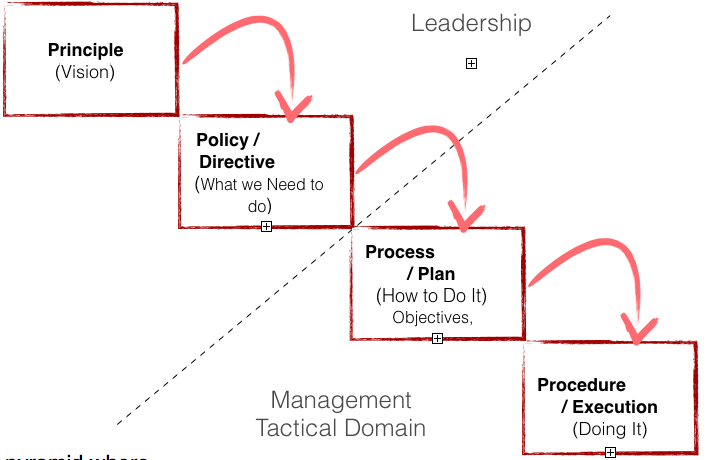
I have spent many years working with executives in developing their corporate strategies. Much of the challenge I encounter is in cascading strategy into actionable initiatives and results. The journey towards creating a strategy cannot be confined in boardrooms and planning frameworks. What is often lacking is a clear transition between what is conceptual or abstract into something that everyone can grasp and translate into action in their daily working lives. For the most part, strategies tend to be cascaded from the top-down. I developed this illustration to explain this cascade:

Screen Shot 2015-01-04 at 7.40.34 PM

In the best cases of a typical “top-down” scenario, there is smooth transition between the strategic and tactical domains and everyone knows what to do. They have a clear understanding and commitment to their contribution to the overall strategy.

In an alternate approach strategic development could also be driven from an inverted pyramid where people down the line are recruited to developing top-level strategies. In this way, strategic planning turns into democratised process that ensures collaboration at every stage; from development to execution planning. The process tends to be inductive rather than deductive.

By engaging people who primarily work within the operational domain, strategy is better understood to include the strategic and the operational perspectives. Cross functional collaboration also ensures that strategy is understood down the line by making sure that everyone is looking at the same thing. Everyone knows where they are amidst competition, where they need to be, what they need to do and how to get there.

The key to jumping the execution hurdle is never going to be about answering the “whats, where” and the “hows” but rather the “WHOS”.The most often overlooked partner to strategic effectiveness within the organisation is usually the HR Department. Organisations have a wellspring of talent who can move up from the tactical domains to the strategic domains. There is huge catchment of talent waiting to be developed. HR could also facilitate and create the processes for inclusion and collaboration between levels to develop and execute an effective strategy. Perhaps the “people championing” role has relegated HR into a supportive rather than a hard strategic role over the years but that also needs to change to deliver the numbers.

Categories
Leadership

Leadership in the Time of Crisis

John Baybay 09.10.14 (As Published in the Star of Malaysia)

In a previous article where I spoke about courage, I briefly described the situation of having to be driven into the deep forests of Mindanao passing at least three military checkpoints in a vehicle escorted by heavily armed men. While being in an area of prevalent insurgency and where kidnapping was good business especially with the presence of international mining companies having frequent visits from well-paid expats, there is a static presence of risk and threats to security. While the threat looms over employees on site, this on occasion would sometime escalate to unimaginable speeds and urgency that differentiates an already tense situation to an actual crisis.

A few hours before my actual departure from site, transportation was running late, coordinating communication suddenly became scarce, and I was advised simply to be prepared for an unannounced pick-up. They specifically advised that my things must already be packed tightly (no loose articles) and to be ready at any time to jump into the vehicle and leave post-haste. I asked around what time the vehicle would arrive and they simply answered: “I cannot tell you, just be ready to jump into the vehicle once it arrives!” The phone was put down and a chilling tension came upon me in anticipation of the vehicle’s arrival. Within a few minutes, the pick-up arrives escorted fore and aft with armed men also in the back of pick-ups. They come to skidding stop on the dirt road fronting our camp. An armed man jumps out of the back of our pick-up reaching for my bags and hurrying me by saying: “Let’s Go! Let’s Go!” I jumped into the back seat where I sat next to the Chief Mining engineer and an Expat. We got up to speed in haste, careening at the sides of the mountains at full speed. There was a tense silence in the car with only the sound of my heart thumping in primal fear. The silence was then broken when the engineer says: “We apologise but there has been a threat of ambush advised by our intelligence!” He then casually started his story of being kidnapped once in Indonesia as if “It happens all the time”. The sick mitigating assurance for me is that they at least knew what to do with an impending security crisis. I am here after all writing this article some four years later.

Boardroom planners need to have a deep understanding of the differences between risk management/planning and actual “crisis management”. I have often done strategic lectures covering frameworks for scenario analysis using Causal Loop Diagrams and PESTEL (Political, Economic, Sociological, Technological, Environmental, Legal). While these frameworks are useful in giving us an appraisal of risks, it also tends to abstract the realism and urgency of an actual crisis when it is presented. This tends to differentiate boardroom strategists from war-room strategists. While in a boardroom a leader would ideally facilitate, steer, elicit and seek consensus to issues, a crisis manager might see it best instead to direct action. People sometimes must be “told” what to do instead of being asked.

Crisis is often defined by its urgency. There is no luxury of time for consensus gathering. According to S.J. Venette in “Risk Communication”, Crisis is defined by the following common elements: (a) Threat to the organisation (and its people), (b) The Element of Time and (c) Short Decision Time.
The consequence of having a crisis unmitigated and controlled are usually severe. The urgency and the crisis’ rate of escalation is what makes a crisis unique from other problems. A bad situation could take a sudden turn for the worst if not acted upon immediately. Surely it takes a different kind of leader when faced with a crisis situation. In this case, a leader is also expected to signal a crisis when it is impending or immediately upon its onset. It usually takes a certain amount of experience for leader to recognise when a threat could escalate into an actual crisis. At the onset of an eminent or actual crisis, a leader must be also be able to communicate effectively in order for the organisation to suddenly switch from prevailing a “businesses as usual” mindset into a “crisis mindset”. In the latter sense, a consent to direct immediate instruction and marshal resources at hand are temporarily given into the hands of a situational leader. These crisis leaders either rise up to the occasion at the onset or appointed immediately during the recognition or the signalling of an impending crisis.

In my experience in working with the exploration and mining industries, I found that these organisations are always vacillating in the frays of risk and crisis. They are usually subjected to natural and environmental risks, regulatory and social risks, security and insurgency / terrorist risk as well as confrontation and violence. The environment is volatile. I have found that the best crisis leaders are those that immediately take to the field to get a firm handle on the situation. It takes a certain amount of field command. An experienced crisis leader exhibits a certain “grace under pressure” while still acting urgently upon the situations presented to him.

The paradigms of planning still remain although these are taken up in faster cycles during a crisis. Intelligence / information and communication are paramount in importance. These three steps are usually taken up in constant and dynamic cycles: (a) situational appraisal and intelligence reporting (b) marshalling of resources (c) execution and monitoring. Strategic and tactical interventions are taken in very quick cycles until situations are controlled. I have seen crisis situations where round the clock (hour by hour) monitoring is required. War-room activity is hectic. When action and monitoring cycles are getting spaced apart, it usually signals the containment of crisis situations. This eventually stabilises and once announced as “under control” work resumes and activity then goes back to the usual pace.

The principles of Engagement also apply to Crisis Leadership. During a crisis situation, the most precious commodity that a leader should marshal is Trust. When leaders are trusted, it is easier for them to get a consensual control over direction and the marshalling of common resources. According to various sources there is usually a progression as to how trust is developed.

Confidence: The leader must be experienced and knowledgeable of the current situation
Integrity: The leader has a track-record of delivering on expectations and commitments
Trust: The leader can be trusted enough to direct people and resources in a way that is beneficial to the team and the organisation with utmost responsibility.

Modern business is now subjected to greater accountabilities under the public eye where corporate reputation is sometimes subjected to certain risks and probable crises. There are lessons to be learned across various industries and it’s always useful to look back and take examples of cases of crisis leadership and management as you can never tell when these skills are needed.

Categories
Health and Fitness

5 Things You Can Get to Make Your New Year’s Resolution Work

It is January 5, 2015 8:30 AM. The first full working week in the New Year 2014 and the gym is brimming with “resolutionist” from all over town. All the treadmills are humming along at a 7-minute pace, all other cardio machines are occupied and the aerobic class is fully booked. Zumba is pumping in the background. All the machinery is humming and clinking at a frenetic pace. Fast forward 30 days later and 50% of these resolutionists will be gone. Many of the treadmills would be unplugged to save energy and what would be left are the typical gym rats shaking their protein shakes at the sidelines giving unsolicited advice to anyone who makes eye contact.

According to a recent article 60% of gym memberships remain unused after the 1st month of purchase and with all this reading and talk about fitness, a majority of people simply quit from their resolutions in less than a month! While many of us are quick to condemn the failure to lack of commitment and discipline, integrating your fitness goals into your regular habits is more often easier said than done. The fact of the matter is that 9 out of 10 resolutionists will quit on their fitness and weight goals by March without getting any results from the effort.
While your goal is to reduce your intake of calories and burn more through exercise, many of us don’t have system to track progress. Worse, after a hard session at the gym, we often over compensate by eating the equivalent number of calories suitable for Sumo wrestler. The average gym session (1 hour) could burn off 500 calories but most of us have the tendency to eat more than 1000 the minute after you leave the gym. The key is to make some tangible investments that keep you “moving” and monitor your progress. Some of the best investments I have made that had me losing 10 pounds and keeping it off during the holidays were the following:

  1. A Fitness Tracker. You can get a pedometer and calorie counter from the app store for free; this helps you monitor the amount of steps you take. The challenge is take at least 10,000 steps a day as described in this site. Getting a fitness tracker (device) as described in our earlier article could help you track your progress in walking and running, it comes with a calorie counting app and even helps you monitor your sleep patterns. iHealth comes with a full dashboard which works with other devices that monitor your blood pressure and glucose. The suite is very useful for those who are just starting a fitness program especially for those who have hypertension and diabetes. Email us at john@projectbinc.com if you’re interested.
  2. Some Running Shoes. If you’re reading this article in early January, chances are, you can get a pair of “decent” running shoes as described in this article for 50% off. Not only do you lose some weight from running, but you also get a bit of “street-cred” if you decide to run your first short race. Packing a pair of running shoes the next time you travel also helps you keep in shape while you’re out on a business trip. Not to mention that most hotels also have their own health clubs.
  3. A Bicycle. One of the best investments I’ve made in fitness was a mountain bike. Not only could you commute with it, you also have a chance to see the best of the country by being outdoors, not to mention that a vigorous off-road adventure could burn up to 700 calories per hour. Cycling is also gentler on the joints than running and could be your 1st step in getting into more competitive sports by building your cardiovascular health.
  4. Friends. Getting a fitness buddy or joining a club motivates you to stick with your program. Being part of a team also ensures you receive motivational as well as technical support for you to take it up a notch. If you’re looking at joining a mountain biking club get in touch with EXO (Executive Off-Road Cycling Association)
  5. Sleep. Don’t forget to recover! As you push yourself to higher levels of fitness, do remember that you only get stronger as you rest. Make sure you add in an hour of sleep for every workout session. Try to go for both quantity and quality by getting at least 6 hours of sleep at 80% efficiency. You’ll be surprised that a power-nap could get up to as much as 100% efficiency and could boost your performance and alertness for the rest of your day. Making sure you recover could prevent your from burning out before reaching your goal.

As it is with any effective planning, the secret is in “breaking-down” your goals into smaller objectives. Quantify your targets and manage your time more effectively. Try to put in at least 2 hours of cardio vascular exercise per week. While 2 hours might sound like too much, you will find that “breaking-down” your sessions into 30 minute intervals spread across your week could give you some very effective results to start. Combining this with other habits such as walking around the office more, parking a bit further and doing a 7 Minute Workout. Walking to the store might not be as convenient as driving, but it is usually simpler and comes with the benefit of burning off some extra calories.

Categories
Life Management

Getting the Best out of the Worst! 4-Ways You Can Make The Best Out of the New Year!

2014 has been marked with some of the worst disasters we have seen in the region’s history. Media was abuzz and rightly so. Indeed we do not even have to look very far to appreciate the disaster of Malaysian Airlines Flights’ MH 17 and MH 370. These were disasters that are likened to a lightning striking twice in the same place within the same year. These unfortunate occurrences do prove that the worst things can happen not only once, but twice! Shortly after, just before the end of the year, the airline disaster of Air Asia QZ8501 gripped us! Lives were lost, families were affected and eventually business and everyone is affected.

On a lighter note, the year also brought about the shocking news that Hello Kitty is not actually a Cat; Despite being a Kitty! The news had taken two generations of people aghast with those who always thought Hello Kitty to be everyone’s lovable pet. In more recent news, Instagram’s Bot Purge had caused Justin Bieber 3.5 million followers! It seems like he had a population of followers who were not actually real people. I could not help but crack a smirk at this bit of news only to find that Kim Kardashian is faring a bit better than the Bieber. Some celebrities seem to be taking things worse than others; perhaps coming to a stark realisation that they were not the big leaders they thought themselves to be. This was a bubble well popped!

The Philippines, had taken another hit from mother nature via typhoon Ruby and came out better this time around with much less damage also owed to the lessons of the previous year.

2014 was an interesting year which was highlighted both by major and minor tragedies. All of which should be lesson for all of us. We need to take the good along with the bad, as many would say but how does this affect your life for the better? Personally, this writer has seen better years. Out of some of the debacles, come some of the best learning moments in my life. What could be a loss in the more obvious fronts such as career and money, on the flip-side could be one the greatest wins in the game of life. In a previous failure, I forced myself to recount what mattered most and came up with three things: Faith, Family and Friends. With the constant undulations that life brings it is good to look at these three things as a constant with maturity begging for more discernment as time goes by. 2014 has been an exceptional teacher in this regard.

In the backdrop of your personal life lies the usual business of the day, but this does not mean that you have to leave everything you learned at work once you have left the office. Whether we like it or not, work is a part of us and occupies most of our waking day and the same strategies and metrics that apply in the workplace can be carried over to your personal life. Life needs to be managed just as anything that occupies your time. With some of the woes that come with life, come some of the greatest gains in learning. Here are some of what take the top spots on my list.

  1. Focus on What Matters: While saying “money isn’t everything” could be considered a cliche, much of it rings true especially when the chips are down. As said earlier Faith, Family and Friends tend to bring back disproportionate rates of returns when considering what you get back in exchange for the time invested. Keeping an eye on the three also help us manage the paradoxes of earning and quality of life. Back in 2012, I racked-in the most billable hours in my consulting career only to fail the stress test on my annual physical exam. Top that with not being mentally and emotionally present during the most important moments in family’s life. A year lost in connecting with your love ones cannot be replaced by money, especially with those who have passed away. We spend so much money on stuff rather than spending time with people. In the end you may have fat account, fat around your waist and still be emotionally and spiritually bankrupt. When a downturn occurred during the following year I found my Faith, Family and Friends with me through my trials. They helped me get back on my feet, encouraged me and even helped me venture towards things that I love to do. I am doing them right now as I write this article.
  2. Let-go of Heavy Baggage: You will find things and even people are not necessary to take on your journey. I have found that some of the same people who have patted my back during my career highs were the same ones that were biting it when I was weak. In the end you will realise that we spend too much time with people who are only with you due to strategic interest. Some were with you because of your material generosity and your image. You will find that once they get what they want in one way or another (which sometimes does not include you), they are fast to step on you to advance themselves. They disguise their advice under a veneer of honesty and sometimes with twisted principles. In the end they are full of negativity, unmet needs which you cannot fill and jealousy. Know the signs early, accept the brutal facts, forgive them, and move on.
  3. Find What Ignites Your Passion: Another life paradox is finding what you truly love during the worst moments of your life. When things take a downturn, you will suddenly reconnect with your forgotten talents. They were hidden deep all along! Some of them could be a bit detached from what you do for money. What you realise then is that having a job could be different from making a living. Try to use this time to realign your career and priorities. Try to identify things that you would be doing anyway, with or without the money. Get in touch with your God given talents and strengths, combine them with your zealous passion and you will find that the amount of effort will yield exponential returns. Turn your talents into a competitive advantage by applying the time to develop them. Know your talents and passion and do invest the time to develop them!
  4. Multiply Yourself: Connect and Collaborate with others. Share your passions and invest in fruitful relationships that develop your interests and open new perspectives to create new possibilities. Commit to a positive change beyond yourself and beyond your shores. Be accountable to the people around you. Take the lead if you must, but lead responsibly.

Many great things could come out from the worst. It is a matter of perspective but anything you do always remember to be authentic. Always keep your Faith, Family and Friends. Keep your eyes on the horizon and your feet on the ground. Live simply but love extravagantly!

Categories
Leadership

Credibility is Where the Leader’s Cookie Crumbles

Originally published in the Star of Malaysia – Leaderonomics Section
10.06.14

In a previous article about Crisis Leadership, I mentioned that there were four levels to Human Engagement as written by Gallup authors Fleming & Asplund. I explained that one has to progress from Confidence to Integrity, and from Integrity to Trust, and from Trust to Passion. There are four levels for this progression and ultimately, it becomes easier for us to understand the concept as to why people follow some leaders passionately. We are given the wrong impression that it is either we have it or we don’t. Passion is the result of process and one does not become an effective leader overnight. Even as I explained that Crisis Leaders have some of their leadership leant to the them by the situation, its implication also means that their authority is also consented upon them by the people they lead. There are however some prerequisites.

To emphasise: People “allow” leaders to lead them. While there are many cases where leadership has been implied or stated because of a position, this does not translate directly into influence which ultimately defines a leader’s effectiveness. Credibility is Where the Leader’s Cookie Crumbles! In John Maxwell’s book: “The 21 Irrefutable Laws of Leadership”, he described his 6th Law as the “Law of Solid Ground” – Trust is the Foundation of Leadership (55).

Just as Fleming and Asplund describe Integrity and Trust in “The Human Sigma”, John Maxwell goes on further to describe the importance of Trust; I quote: “Trust is the foundation of leadership. To build trust, a leader must exemplify these qualities: competence, connection, and character”. While this could be considered as a generalised view of how trust is established, we could see how some of these elements we described have their equivalencies between Fleming & Asplund and John Maxwell. Competence is what builds into Confidence, while Integrity and Character builds into Trust. Trust and Passion are the ultimate result.

There seems to be a common understanding that competence is linked to knowledge or Intelligence Quotient (IQ) while connection could be classified as a function of Emotional Quotient (EQ) and most recently, character is linked with what is now knows as a Moral Quotient (MQ). Given these dimensions added to what is known to be prerequisites for effective leadership, one could easily recognise that you cannot get to the top with just intelligence alone. While knowledge and interpersonal skills and practice could give you the first two prerequisites, we have seen some of the most recognised leaders in history tumble with just one blow to his character.

Moral Quotient (MQ) tends to deal with person’s Integrity and forms much of the bases for trust. Integrity could be defined by its root word: “integer” which is a mathematical term that means “whole number” or a non-fraction. It is further defined as “one that is complete in itself”. The literal meaning lends a number of similes to a person’s character and integrity. A leader of integrity must be in a state of being undivided and consistent. There should be no dichotomy between a leader’s moral and professional life. There are no compromises when it comes to integrity and character.

A leader’s character and integrity are built over time as character is constantly built up with “consistency”. Character and trust cannot be gained overnight. Leaders are always set at the front lines of scrutiny. They are constantly being watched and assessed by people to see if the leaders will deliver consistently. It is implied that leaders and their followers have a psychological contract between them, such that leaders are beholden to their followers in constantly delivering on their promise. This consistency is what builds into integrity in forming his character and thereby results in the people’s trust. A lack in consistency and integrity therefore compromises a leader’s ability to lead. Above all things a person’s moral integrity defines his character and his capacity to for effective leadership.
JUMPING THE CREDIBILITY HURDLE
While we tend to look at effective leadership as the ultimate result of years of character development, we are also presented with the opportunity to lead on a daily basis. Keeping the long-term in sight, we need to use this day to build ourselves to be the leaders that we would like to become. We have to take ourselves back into first steps of developing an acceptable level of “credibility”. Credibility opens the doors to leadership but what exactly gets you through? Credibility simply put, is defined as the quality of being believed and eventually trusted.

Competence resulting in Confidence: A leader must exhibit a certain level of competence in knowing the subject matter, issues, and objectives at hand. While it might be asking too much to have a leader that knows everything, the leader must exhibit the ability to know where and from whom to find the answers to issues. Exhibiting an ability to navigate competently through issues develops confidence in the people you are leading. Do not pretend to be a “know-it-all”. Exhibit control responsibly and with respect for people and process.
Integrity as a Result of Consistency: Always deliver on your promises and be known as a leader who brings consistent results. It is inevitable for you to fail at certain objectives, but do so in a way which communicates how and why these failures happen without making your team members look bad. Take responsibility and focus on the root causes instead of passing the blame. People want to be led by people who make them feel safe. Always speak the truth and be who you say you are.

Being the leader you envision yourself to be might be a steep goal based on the many things we have said about integrity and character, but everyone needs to start somewhere. Start from where you are! Be excellent at work. Be a positive influence to the people around you. Be passionate about what you do and create a reputation for consistently delivering the results. Most of all, be true to yourself so that you could always speak and act with the truth. Perhaps if you cannot find yourself doing and leading from where you are in the next few years, then you owe to everyone else to lead yourself out from where you are into a workplace that is better for everyone.

Categories
Leadership

Change Management and The Iron Lid

08.20.14 – Originally Published in the Star of Malaysia

The legacy of the industrial revolution has left much of what remains to be a way of thinking that the human organisation will respond predictably according to new concepts and strategies. Throughout the 80’s and 90’s the call for reengineering has popularised the subject matter with many of these, being also rebranded as change management. Awful as it may sound, the perils of not being able to effectively implement change could mean the demise of the organisation. Change management while it seems internally focused within the organisational context is actually dictated externally by the changing environment. Change or adaptation is forced rather than implied. Change is a matter of success and survival.

Change imperatives are so powerful that strategies need to be adjusted to the point where mission statements sometimes need to be overhauled. It is easy to craft change management initiatives within the confines of conceptual frameworks. It all makes sense on paper however when the rubber meets the road, we realise that the results of change initiatives are more difficult and less predictable than previously thought. The human element is often the most overlooked aspect of these initiatives.

COMMON REASONS FOR FAILURE

Focusing too much on the results rather than the process:
There is very little argument as to why change is needed in response to the changing environment. The top brass tends to look more at the ideal outcomes resulting from change, but have very little appreciation as to how it affects human individuals working in the organisation. The path to change is riddled with human land-mines. The human experience in implementing change is often wrought in emotional investment. Effective change management needs to focus on how it is implemented with sensitivity to the human experience as it is being effected. The focus should be shifted to process rather than pressing others for immediate results. Managers need to realise that they are managing the human experience within the organisation.

Motivational Misalignment:
Change management usually entails some changes in expectations from both the side of employers and employees. People in organisations tend to fall under the concept of a “Psychological Contract”. The Psychological Contract concept was popularised by organisational and behavioural theorists by the names of Chris Argyrist and Edgar Schein back in the 1960s. In their studies it was observed that employees and employers have an implied notion of what was expected of them as makers of the “psychological contract”. At the time of employment both employers and employees have a good idea of what to expect from each other. This expectation tends to be reinforced over time and becomes the basis of their relationship. When change is being implemented, these mutual expectations tend to get misaligned. The objectives of employees and the new expectations of employers get disconnected. It is like renegotiating the psychological contract. The old motivations for career advancement sometimes change along with some of the investments made in the old path. This causes a great deal of insecurity and distrust towards management. It is very important for managers and leaders to get down to the level of their employees to reinforce trust with the assurance that they care about the future and careers of their employees and the commitment remains for the mutual benefit of the employee and the employer. If personal motivations and corporate intentions remain to be misaligned, there is no way for the employee but to see his way out or just wait for a golden parachute.

Underestimating the Personal Impact of Change:
A focus on ideal results also overshadows the impact that is brought about by change. Leaders must realise that embracing change also entails being open to changing “the way we do things”. An employee spends years or even decades to be proficient in what he does. He is usually appraised and remunerated in similar ways. When change is evident, this investment to mastery is sometimes cast aside for new and improved processes. Also, rapid changes in the industry sometimes force companies to restructure their value chains to the point that some of their key activities could be outsourced, automated, or junked. The same goes for the people that use to own these processes, they could either be repurposed or scrapped. That is the prevailing fear among employees in company that is going through some major structural changes.

LEADERS AS SOLUTIONS
Fear often tends to point towards the worst scenarios. It is the role of leaders to accurately communicate the extent of change management initiatives as well as explain exactly what the process entails. Leaders must have a concrete knowledge and be able to explain the scope or extent of their change initiatives.

Blue Ocean Strategy Authors, Kim & Mauborgne explains that “Fair Process” needs to be observed and that Fair Process is described as having the 3E’s namely: Engagement, Explanation and Expectation clarity. This idea is self-explanatory in its simplicity where you “Engage” employees in discussing the strategic change initiatives, “Explaining” why and how this will be implemented, and clarifying the “Expectations” from the makers of this Psychological Contract.

The greatest barrier to change is often the leaders themselves, but they can also be the best pivotal elements in a successful change management initiative. The ability to change operates under the principle of an iron lid. Leaders can act as a lid or limit to change potential but conversely, they can also be the agents. When looking at implementing a change management program, the board also needs to identify localised leaders which form the vortices of influence within the organisation. These kingpins also serve as thermostats or regulators for organisational behaviour. Organisations need to identify, develop, and invest in the leaders within to effectively implement change. Leaders must also need to have a human approach towards their team in building confidence, integrity, and trust for a smoother transition. Focus on “how” you do it rather than blindly trying to achieve the “what”.