Categories
Uncategorized

Debunking the Singaporean Laksa

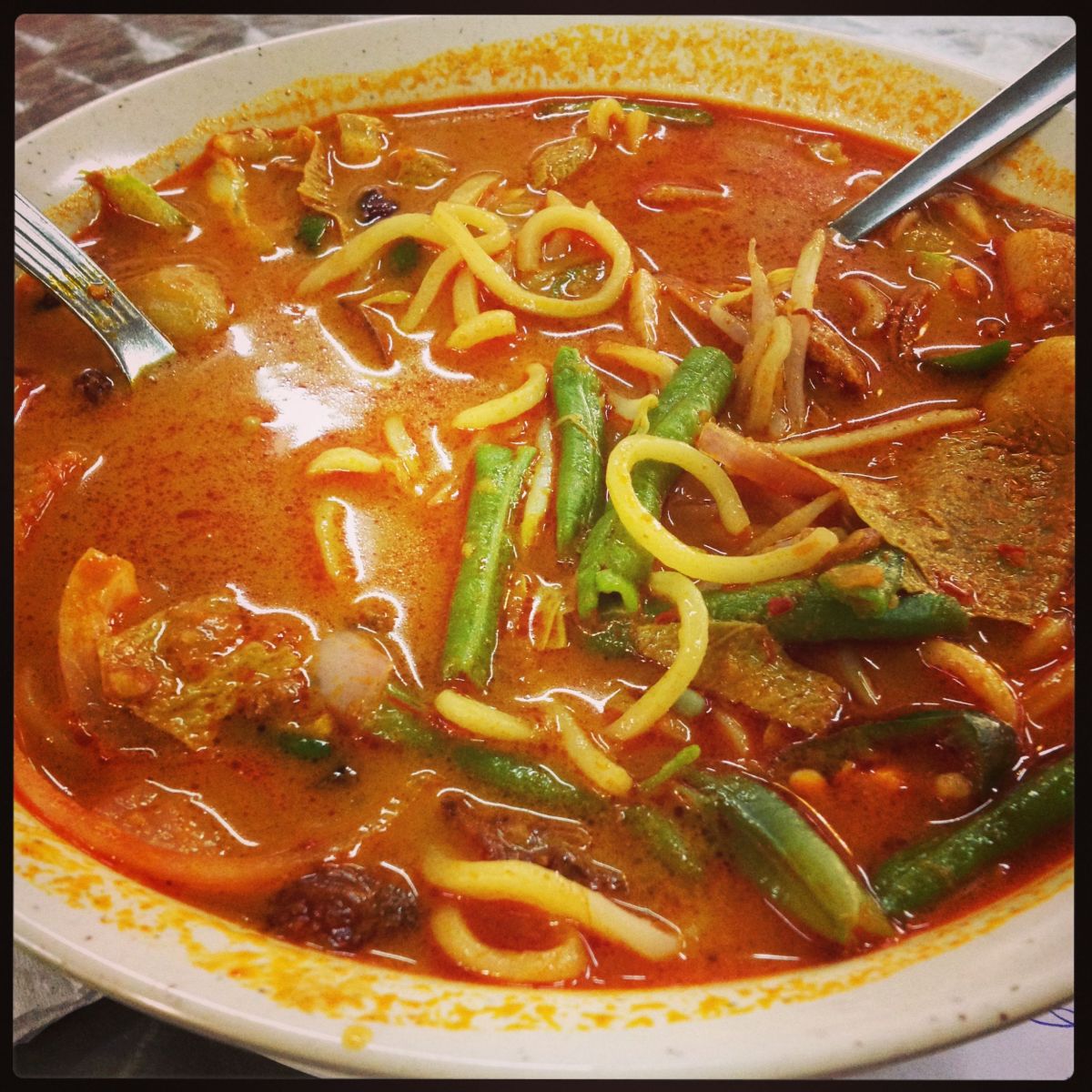
Before the Laksa goes by the way of “chopsuey”, I would like to say my piece that I myself had been deceived that the origins of the Laksa (A rich and spicy noodle soup supposedly of Peranakan origins) came by way of Singapore and to the world. It did not come as a surprise, that when I posted my Curry Laksa lunch while working in KL, it prodded a craving for some of our netizens to go the nearest Toast Box in Manila or the nearest Singaporean restaurant. While many tourists and especially Filipinos have been initiated into the world of Singaporean street food, I would have to say that most of what we have seen is more of an audition to the real world of culinary performance that is Malaysia.

Having just recovered from cellphone bill-shock where my addiction to producing instagrammed food-porn had gotten the best of my sensibilities, I might as well make the most of out it by sharing the experience with the rest of the world. The world wherIMG_1261e food is celebrated and no other place does is so well than Malaysia. It seems like everyone there is eating all the time and everywhere. While having spent a month in KL, I came across an article which read: “Wasteful Ways of Malaysian Gluttons” The Star front page article explains that Malaysia produces some 15,000 tons of food daily; the wastage that comes with it is seen to be a problem. Placing gluttony aside, we must marvel at the sheer volumes of food being produced on a daily basis in Malaysia. Within this cornucopia, it is obviously easy for anyone to find something very good, somewhere close and at any given time.
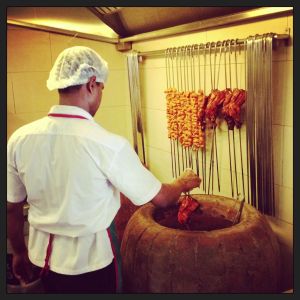
What makes food in KL a few notches above Singapore besides the sheer volumes to work from is a greater sense of authenticity. While I consider SG to be a true cosmopolitan city that provides the most of everything, there is something about Malaysia that is still deeply ethnic. While some complain that the society is overly so, its best reflection could be seen in the food. I stayed in Brickfields where instead of gaining weight, I was actually able to shed a few pounds. With such a rich selection of Indian food, I actually had the choice of eating vegetarian throughout most of my stay. A decent meal would cost somewhere between RM 6.00 to RM 10.00 (Just don’t order the beer). That is relatively cheap even in comparison to Manila prices. The food also allows us to go deep into the country’s culture with choices of Indian (primarily Tamil), Chinese (Hokkien, Cantonese) and Malay. It is said that every region also has its specialty with Penang reaching recent renown. Richly diverse and Richly ethnic!

IMG_1298Could ethnic expression be a bad thing? Certainly not when it comes to food. Not that I am downing Singapore, as a lot of Malaysia have funneled into the once island state. But in the process of funneling, some of the ingredients might have been lost? Perhaps, Malaysia is Truly Asia. Nowhere else better explored but through food. I hope to come back for some more of that Rojak!
Categories
Uncategorized

Fair Process vs. Shocktivism: A Case-study for Civilized Engagement

It has been more than a month since I last wrote “Fair Process and the Myth of Inclusive Growth” and yet the issue of “Fair Process” or the culture’s lack of it still remains. According to Kim and Mauborgne’s book: “Blue Ocean Strategy”, Fair Process has its roots on Procedural Justice as much as the practice of Due Process is derived from the very same concept.

While Due Process alludes to our justice system, the concept of “Fair Process” is easily understood using a more practical managerial perspective. During the 70’s, two social scientists by the names of John W. Thibault and Laurens Walker concluded that: “People care as much about the justice of the process through which an outcome is produced as they do about the outcome itself. People’s satisfaction with the outcome and their commitment to it rose when procedural justice was exercised.” In this sense, “The means justifies the end as much as the end justifies the means.” While this statement is quite easy to understand, it apparently ends with consistent results. Ergo: Inputs + Process = Output. With the same equation, it is easy to understand why outputs or outcomes are easily spoiled by junk processes. This provides a clear case as to why civilized engagement is usually the best approach.

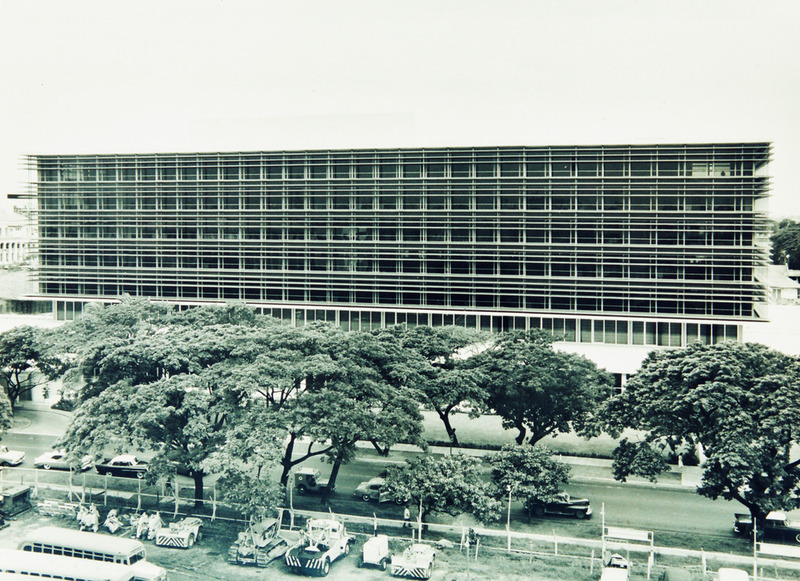
In more recent days, the dynamism of the social media has provided some of the greatest examples for our comparison. The case of the Philam Life Auditorium Theater on UN Avenue, Manila has been the subject of “Saving” and perhaps rightly so. The edifice is regarded as one of the country’s cultural and historical gems with acoustics designed by Bolt, Beranek & Newman, who were also responsible for the Sydney Opera House, United Nations Assembly Hall in New York, Lincoln Center’s Avery Fisher Hall and the Cultural Center of the Philippines. The building was designed by renowned Filipino architect Carlos Arguelles and was rendered in a forward thinking approach that symbolized the Manila that rose from the ashes of WW2. The thoughts of this cultural icon being demolished certainly roused the ire and activism of our netizens especially when it was found that SM had acquired the property. Twitter and Facebook ablaze, netizens rushed to “save” Philam Theater (I might’ve been one of them) via online petition. One infamous shocktivist came brandishing a placard of profanity with direct personal attacks against the owner of SM. This was followed persistently by vulgar and hateful tirades over the social media. In this case the activist would rather say “F@*# You!, just to have the last word.

While I would also like to save the theater, I have to say that I cannot subscribe to this type of approach.
Unfortunately, these types of antics are commonplace in the Philippines where our brand of democracy finds it acceptable to walk out of hearings, negotiations and just about any form of due process. Dramatic as these displays may be, the question remains whether they actually work? With much freedom gained, are we just as civilized? Is there room for fairness and justice?

From a management perspective, Professors Kim & Mauborgne gives us a simple and almost prescriptive approach in their “3-E Principles of Fair Process”.

  1. Engagement: Involving individuals in decisions by inviting their input and encouraging them to challenge one another’s ideas.
  2. Engagement communicates respect for individuals and their ideas and builds collective wisdom. It generates better decisions and greater commitment from those involved in executing those decisions.
    Explanation: Explanation reassures people that managers have considered their opinions and made the decision with the company’s overall interests at heart. Employees trust managers’ intentions even if their own ideas were rejected.

Expectation Clarity: stating the new rules of the game, including performance standards, penalties for failure, and new responsibilities. By minimizing political jockeying and favoritism, expectation clarity enables employees to focus on the job at hand.
Pages 174-176, Kim & Mauborgne. 2005 Blue Ocean Strategy.
Boston, Massachusetts. Harvard Business School Press

The case of following a “Fair Process” was clearly demonstrated when Olivier Ochanine followed a civilized approach that can be seen highlighted in Paul Farol’s article “Olivier Ochanine Defines Advocacy”. http://getrealphilippines.com/blog/2013/04/olivier-ochanine-the-real-cultural-activist/

By following a Fair Process everyone wins; and in this case the Philam Theater has been saved. While many Filipinos seem to have a penchant for impact and drama, sometimes taking a management approach to negotiations could be the best way to achieving positive results. As we are now learning, shock could only create a lot of attention in the beginning but fails to deliver the objective in the long run.

From the procedural justice point of view, negative drama and shock that we have gotten used to also sometimes defeats the point of activism itself. It also causes undue delays to processes and its resulting justified resolutions that could benefit the majority. Justice delayed = Justice denied. Having the last word rendered in vulgar punctuations leave not much room for anything else and closes the door on the possibilities of positive outcomes. Let’s be fair and civilized. I am sure our society and our freedoms could move a lot further from where we are now.

Categories
Uncategorized

The Pork Ball From Different Angles

I have been fortunate enough to have been invited to the Rotary Club of Manila by its President Rudy Bediones at the Manila Polo Club, August 29, 2013. The Rotary Club of Manila (RCM) has a long tradition of inviting excellent speakers, many of which come from their esteemed membership. The motive for me was both personal as I wanted to see some of my late father’s old friends as well as the fact that I was drawn by curiosity in hopes I could learn more about the “Pork Barrel” from an alternative angle.

The meeting was called to order around 12:30 PM followed by the usual Rotary rituals. The guest speaker was Rep. Roilo Golez of Parañaque who gave a presentation entitled “Pork Barrel: A Requiem for the Good, the Bad and the Ugly”. With such a title, one would expect a fair and balanced view of the Pork issue but whatever seems fair always comes from a matter of perspective.

Rep. Golez proceeded to induce references on the Pork Barrel, starting with its history and usage in other countries such as USA, Germany, Australia etc. citing some of the worst cases abroad. The point being, that the pork barrel is used elsewhere and that some of the worst cases are perhaps not representative of the general scenario. The argument was then segued to how he used his Pork Barrel (Priority Development Assistance Fund) with a list of achievements such as the most number of covered courts, school buildings, infrastructure etc. With such as enormous list, perhaps the Pork is a good thing? To note, not a single centavo was given to any NGOs!
He really had me going until the point where I felt that I was being led. The argument is not that the money could do no good, but whether or not the money should be allocated and dispensed in that manner. Ironically, he made some validations in his speech that strengthens the argument for abolition.

  1. The pork can be easily abused: This is not the case just in the Philippines but also in other more developed countries which you would assume have better safeguards and access to information.
  2. The pork barrel is systemic ingratiation: The pork barrel systematizes the monetization of political capital flows from the President, all the way to the local constituents through the hands of the legislators. With much political capital borrowed from local constituents when running for national office, much is owed back and paid back in the form of the pork barrel funds. This perpetuates the cycle of ingratiation and systemic corruption. Secondly, with this type of monetary ingratiation, the principle of checks and balances between the two branches of government is destroyed.
  3. It is discretionary in nature and therefore arbitrary: Rep. Golez cited an example where a congressman as a legacy chose to allocate all of his pork barrel to fund 40,000 scholars in his district. While scholarships are never a bad thing, it also begs me to think whether or not this was the only need of the district over things such as: food security, health, infrastructure and disaster control. It just proves that the usage of funds is arbitrary and according to the whims or preferences of the Representative.

Some of the highlights of the luncheon came during the Q&A portion where Roberto Pagdanganan of Bulacan a former Representative himself cited the legislative praxis of former statesmen such as Sumulong and Diokno. Emphasizing that the job of the congressmen is to make laws and policies that would help their constituents rather than choosing and implementing projects themselves. He also mentioned that the ingratiation between the executive and the legislative branch also ruins checks and balance. “How can we effectively check and balance them, if we are ingratiated to them?” (nonverbatim)

Former Representative Payumo of Bataan also cited an example where constituents would often approach their representatives for support such as medicines in a far-flung place. The congressman would usually give out of his pork barrel funds with uncertainty that the support would go where it should. The point being that the congressman’s office usually would not have the administrative means to check and make sure that projects are implemented properly or if implemented at all. It is the structural limitation of their offices.

The primary function of legislation is thus legislative in nature and should have nothing to do with the administration, management and funding of projects. It is best that the representatives’ competence is reserved for “The House” where it belongs otherwise it is performing a disservice to its constituency and the nation.
The irony here is that where administrative capacity is lacking to select and implement projects among legislators, there are many legitimate, sustainable and competent NGOs that could implement many of these projects with utmost transparency. It is unfair that these NGOs are demonized due to a scandal involving government and the rotten eggs. Shame on them who are guilty of colluding but spare the innocent who continue to do their jobs better than you can, with or without your pork barrel support.

To end, I’d like to thank the Rotary Club of Manila who gave me the opportunity to write this article with an even greater view for the Pork Barrel issue due to the Speaker’s presentation and the rebuttals of his colleagues. It is a privilege to see the pork barrel from different angles, which makes an even more compelling argument for its abolition. While everyone seems to have their eyes on Napoles, let us keep our eyes on the ball instead for its abolition.

My special thanks goes to Rudy Bediones who has allowed me to see my dad’s “old” club in a “new” light. I am assured that RCM is relevant still. Hoping for more enlightening discussions such as this.